
written by Jenny Gray, Educational Psychologist
Many of the young people I’ve had the privilege of working with haven’t been asking, “Do I have dyslexia?”
They’ve been asking, “Why do I find this so difficult when others don’t?”
For many families, finding an answer to that question can be a turning point. It can shift the narrative away from inaccurate and unfair assumptions about “not trying hard enough” towards a clearer understanding of the underlying difficulties that may be making learning feel more effortful.
I was recently working with a child who had always had a strong vocabulary, good understanding, and an excellent memory for facts. They were often described as being “a little bit behind” in school, despite learning seeming to require significantly more effort than for their peers.
Tasks took longer. Written work felt demanding. Keeping pace in class was difficult, even though they understood the content. At times, the school’s response was to keep them in during break times to finish incomplete work—perhaps reflecting that the underlying reasons for their difficulties had not yet been fully understood.
Over time, the message became that they simply were not trying hard enough, and this was often internalised as a sense that something was wrong with them.
Through the assessment process, a different picture began to emerge.
While long-term memory was a strength, working memory (holding and using information in the moment) required much more effort. Processing speed was also slower, meaning tasks simply took longer. What had been interpreted as low effort was, in reality, high effort.
For the child and their family, this was a significant moment. It shifted the narrative from “not trying” to recognising a need for support. It also reflects an idea often linked to Dr Ross Greene (Clinical Psychologist)—that children do well if they can. When a child struggles to complete work, keep pace, or engage in the way adults expect, this is rarely because they simply do not want to. More often, it reflects skills that are still developing, or demands that exceed what the child can consistently manage at that moment in time.
Where this interest began
I’ve always had a strong interest in dyslexia. That probably started early on—my mother was a specialist support for learning teacher with a particular interest in working with dyslexic learners. I still remember visiting her classroom as a child and becoming aware that some children experience learning very differently from others, and that some children simply need a more differentiated support framework around them to help them progress.
My mother was a fantastic teacher, and she always prioritised helping children feel understood, encouraged, and safe enough to make mistakes—something that often shaped how they engaged with learning just as much as the intervention itself.
Dyslexia assessment is often thought of as a single test or straightforward “yes/no” answer. In reality, robust assessment is rarely that simple—and nor should it be.
In many cases, support can begin before a formal assessment takes place, and not every child will need one. Where assessment is helpful, the aim should be to provide clarity and a fuller understanding of how that child learns.
A robust assessment should identify not only areas of difficulty, but also strengths, interests, and protective factors, helping recommendations feel realistic, balanced, and meaningful for the child or young person.
This usually involves around two direct assessment sessions with the child or young person, but those sessions are only one part of the process. Understanding a child’s learning also involves considering their wider development, educational experiences, strengths, and the contexts in which learning feels more effortful.
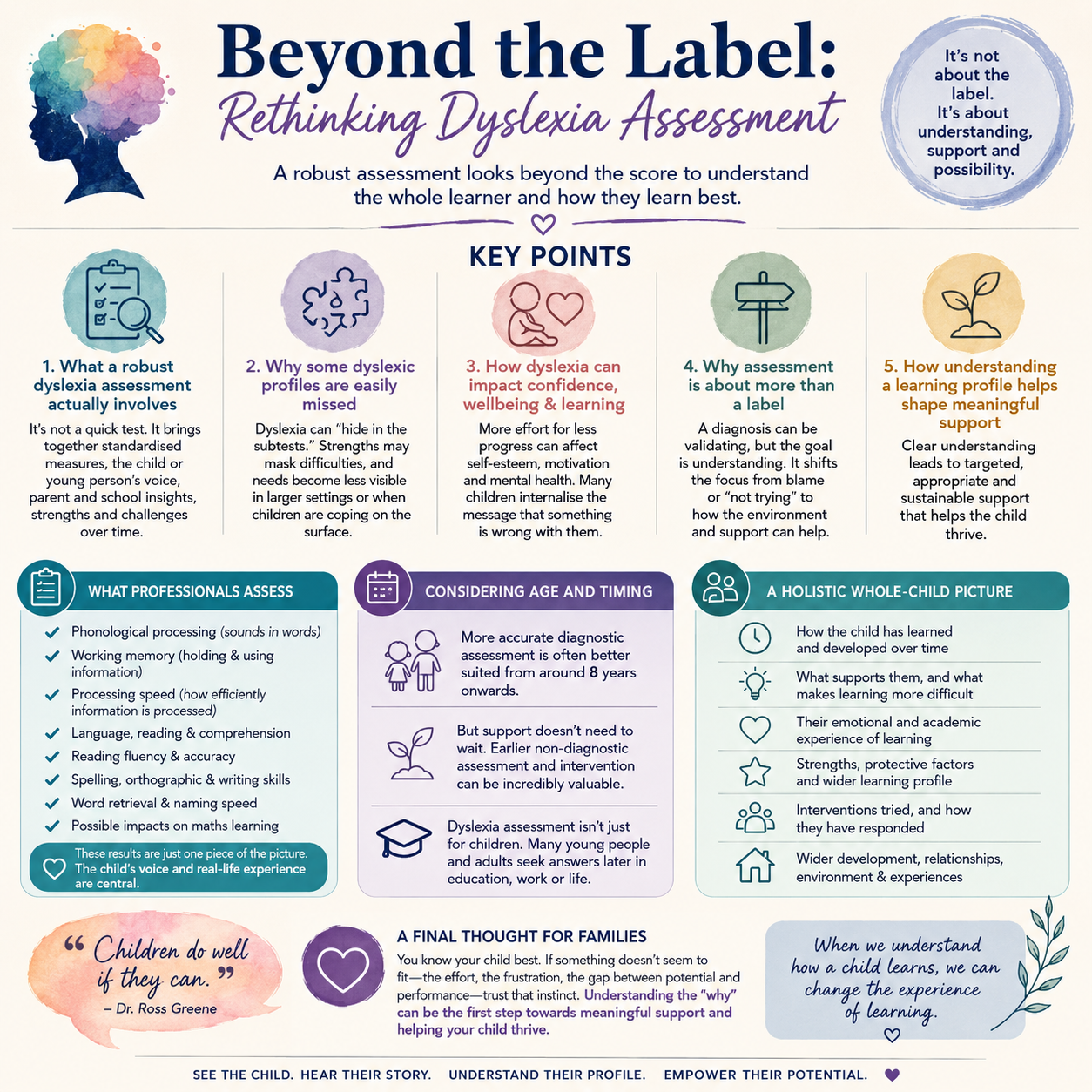
Considering age and timing
Parents often ask what age dyslexia assessment should happen. In practice, this depends on the individual child and the purpose of the assessment.
Research suggests that more accurate and meaningful diagnostic assessment is often better suited to children from around 8 years onwards. Before this age, many aspects of language, literacy, attention, memory, and wider development are still changing rapidly, and children can progress significantly from year to year.
For this reason, more formal diagnostic assessment is often considered more meaningful from around 8 years onwards. However, support should never need to wait for this. Earlier non-diagnostic assessment and intervention can still be very valuable in identifying strengths, highlighting areas requiring support, and helping schools and families understand what approaches may be most helpful.
Dyslexia assessment is also not limited to childhood. Many young people and adults seek assessment later in life, often after years of wondering why aspects of learning or education felt more effortful than expected. This may become more noticeable during college, university, or within the workplace, particularly when exam access arrangements, additional support, or workplace adaptations begin to highlight differences in how someone processes and manages information.
It’s not just a one-off test
A thorough dyslexia assessment isn’t a snapshot—it’s about building a picture of how a child learns over time.
Dyslexia is typically described as a Specific Learning Difficulty (SpLD). This means the difficulties relate to specific areas involved in learning—such as reading, spelling, phonological processing, working memory, or processing speed—rather than reflecting a more generalised difficulty across all areas of development or learning.
Many children and young people with dyslexia also have significant strengths in areas such as verbal reasoning, vocabulary, creativity, problem solving, or wider conceptual understanding, which can sometimes mean their difficulties are initially misunderstood or overlooked.
Current definitions of dyslexia, including the recent Delphi consensus definition, describe dyslexia as a developmental difference influenced by a combination of genetic and environmental factors. Dyslexia primarily affects reading and spelling development, with difficulties in phonological processing being one of the most commonly recognised features. However, working memory, processing speed, orthographic processing, and language skills can also contribute to how dyslexia presents.
Dyslexic difficulties exist on a continuum, vary considerably between individuals, and frequently overlap with other developmental differences such as ADHD, developmental language disorder, dyscalculia, and developmental coordination difficulties.
Standardised assessments can be helpful when considered alongside wider qualitative information. They may provide insight into areas such as:
On their own, however, these do not tell the full story.
The pupil’s voice is central to the process. Hearing directly from the child or young person about their lived experience of learning—what feels effortful, what they avoid, what supports them, and how this impacts confidence—adds a layer of understanding that no test score can provide.
Parents often bring a longer-term perspective, while schools can help describe how difficulties present across day-to-day learning. Together, this helps build a more meaningful understanding of the child’s learning profile and what support may be helpful in practice.
The broader aim is often to understand:
Looking at learning in this broader way helps build a more meaningful understanding of the child as a whole person, rather than focusing only on isolated scores or difficulties.
“Dyslexia often hides in the subtests”
An idea often associated with Dr Kelli Sandman-Hurley is that dyslexia can “hide in the subtests.”
It’s a helpful way of thinking about learners whose difficulties are not always immediately obvious. On the surface, they may appear articulate, broadly on track, or to be coping well. But underneath, learning can require significantly more effort and energy than it appears.
Dyslexia exists on a spectrum, much like other neurodevelopmental differences such as autism and ADHD. Different aspects of a child’s cognitive and learning profile—such as phonological processing, working memory, processing speed, language abilities, motivation, and learning experiences—interact in different ways. Sometimes strengths help compensate; other times, the combination of needs can make learning feel significantly more effortful.
We’re also increasingly recognising that learning differences frequently overlap. For example, ADHD and dyslexia commonly co-occur, which can further shape how a child’s profile presents.
In Scotland, education is designed to be needs-led rather than diagnosis-led. In theory, this means support within schools should be available without a formal label. However, this relies on needs being clearly recognised and understood. For children who appear to be coping on the surface—but who may be expending significantly more effort and energy than their peers—those needs can sometimes be less visible.
As children transition from smaller primary schools into larger secondary school environments, there is also a risk that some needs become easier to miss. The number of teachers pupils interact with, alongside the wider demands of large school settings, can sometimes mean that certain children fall between the cracks. This can particularly affect children who are compliant with school routines and expectations, including those with more compensating dyslexic profiles whose difficulties may be less outwardly visible.
Schools can understandably become focused on emotional responses and distress, particularly when these are the most visible aspects of a child’s presentation. However, underneath the surface there can at times be underlying differences in language, memory, processing, or other brain-based aspects of learning contributing to the difficulty. When these processes are less visible, the reasons why a child may be struggling can sometimes be missed or misunderstood.
What professionals assess for dyslexia?
Across the UK, there is considerable variation in how dyslexia is assessed and identified.
Some schools are very well equipped to carry out their own assessments using specialist staff with experience and training in dyslexia and literacy difficulties. Increasingly, schools may also use dyslexia screening tools as a quick, cost-efficient way to carry out a preliminary check.
Screening tools can sometimes provide a broad snapshot of areas associated with dyslexia, but they were not designed to offer a detailed understanding of a child’s learning profile. Results may occasionally appear within expected ranges, even where a child is experiencing genuine and ongoing difficulties. For this reason, screening tools should not be viewed as a substitute for a full dyslexia assessment.
In other contexts—perhaps more commonly in parts of England—schools may refer families to independent services for a full assessment, while others focus on identifying needs and providing support without formally assessing for dyslexia.
Dyslexia is not typically associated with NHS pathways and is not assessed by GPs. It is also not typically assessed by Speech and Language Therapists or Occupational Therapists, although these professionals may contribute valuable insight into areas such as language, communication, motor coordination, sensory processing, or wider developmental needs.
In England and Scotland, dyslexia assessments are usually carried out by specialist dyslexia assessors or HCPC-registered psychologists with relevant training and experience in this area. However, professionals may use different assessment approaches, frameworks, and terminology depending on their training and practice. Terms such as diagnosis, identification, and confirmation are often used slightly differently across contexts, but this does not necessarily reflect differences in the quality of the assessment itself.
It’s not just about a diagnosis
For many children and families, having dyslexia confirmed can be incredibly validating. A clearer understanding of a child’s learning profile can help make sense of their experiences and reduce internalised feelings of shame, self-doubt, or a sense that something is “wrong” with them.
In many cases, this shifts the focus away from blame or perceived failure towards considering how the environment can be adapted to better support the child’s learning needs, alongside what targeted interventions or supports may be helpful.
Ultimately, what matters most is that the process leads to a clearer understanding of the child’s needs and what will help them move forward.
Why robust assessment matters
Without a clear understanding of a child’s learning profile, support can sometimes miss the mark.
A dyslexia assessment is rarely about a single score or label. At its best, it helps build a clearer understanding of how a child learns, where learning feels more effortful, and what support may be most helpful.
When assessment is thorough and well-considered, support is more likely to be:
Sometimes, that understanding alone can make a meaningful difference.
A final thought for families
For some families, the question isn’t whether support is needed—but whether understanding the “why” behind their child’s learning would be helpful. This may be something you begin to consider if your child seems to be working much harder than their peers, avoiding certain tasks, becoming frustrated with learning, or where your understanding of their abilities and potential does not seem to fully match their day-to-day experience of learning in school.
Parents often know their child better than anyone else. They have known them far longer than any professional involved and often see parts of their child that others may not. Many parents have an instinctive sense when something about their child or their child’s learning does not feel quite right, and that instinct is often worth paying attention to.
We're here to answer your questions, discuss your needs, and provide the information you need to get started with us.
Contact UsSustainable innovations for mental health & wellbeing

Treating the whole person, emphasising the connections between the mind and the body.
We believe passionately in connecting with people to build relationships that enrich lives.
Strategic, purposeful approach to effective collaboration, partnership, and support that furthers the organization’s mission beyond profit.
To help you inhabit your strengths, cope with life’s challenges, and thrive in your unique way
The cultivation of learning, resilience and adaptability, viewing problems from multiple perspectives.
We are not afraid to be different. We try new things and embrace progress. We are committed to being and staying on the cutting edge.
Advocating for the human rights, dignity, and diversity of every person, with respect and compassion.
